
AI is no longer confined to big organizations with large tech budgets. Small businesses today can leverage AI-powered tools to automate routine tasks, deliver better customer service, create content, conduct analysis, and run their day-to-day business. However, considering that there are numerous AI solutions out there, one major question comes to mind – should small businesses invest in AI tools?
The answer is yes, but only if AI tools are chosen and utilized according to business needs.
AI Tools for Small Businesses
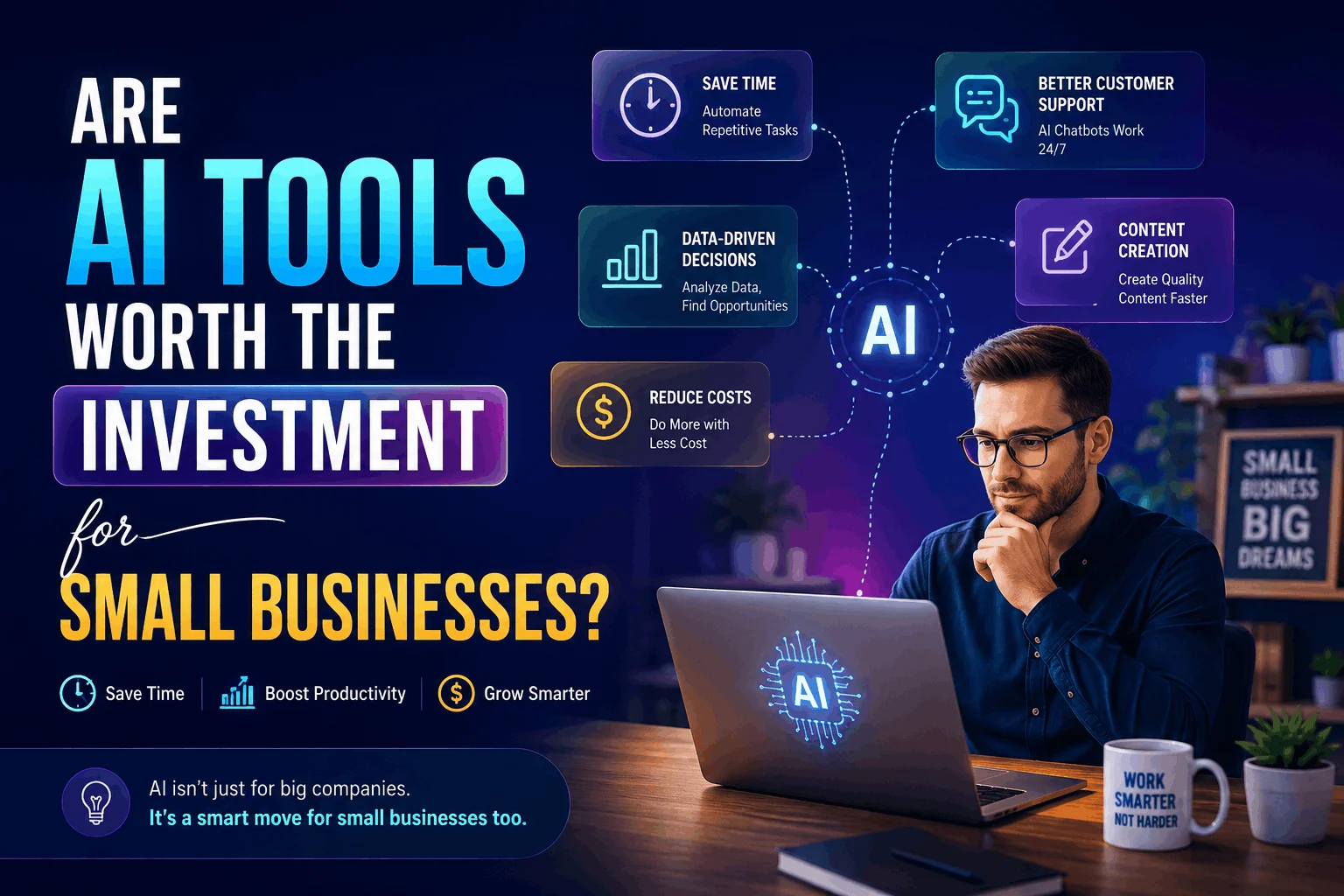
It is typical of small businesses to have limited workforce, budgets, and timeframes. The use of artificial intelligence tools is capable of decreasing the stress by automating routine operations and time-consuming tasks.
One of such applications can be the use of AI writing assistants that will aid in creating blog entries, descriptions of goods or services, emails, and even messages on social media. Companies providing customer service can rely on AI chatbots to provide responses to common inquiries without having to answer each message personally.
The greatest benefit is not in replacing workers but rather in sparing their time from routine tasks.
The Cost Element
The first problem that might confront a small business when implementing any system is the issue of cost. However, AI technology is affordable, coming at various pricing levels. Some software may be provided at no cost, while some require regular or one-off payments.
In such cases, businesses should not be motivated by cost alone. The critical point is the extent to which the tool produces value.
Let us suppose that an organization incurs $50 every month for an AI tool but saves many hours of work every week from its staff. In this case, the cost is clearly worth the investment. On the contrary, spending money on a state-of-the-art AI solution which is hardly used by employees becomes an unnecessary cost.
Where Does AI Add Most Value?
AI can be most helpful where businesses have recurring tasks.
Marketing: AI can assist in brainstorming new ideas, writing first drafts, designing advertisements, and assessing campaign results.
Customer Service: Chatbots can deal with frequent inquiries and offer basic support round-the-clock.
Sales: AI can facilitate lead management, personalize sales approaches, and recognize potential clients.
Administration: AI can aid in scheduling, document drafting, data inputting, and other similar routine tasks.
Data Analysis: AI-enabled platforms can convert bulk business data into valuable analysis and summaries.
It is up to the business and its processes to pick the most fitting solution.

Potential Pitfalls
AI is far from being flawless. Inaccuracies in the information provided by AI, privacy issues, the resistance of employees, and the learning period of using new software can be potential issues faced by small businesses.
Another risk is becoming overly reliant on AI. Human supervision is still necessary, particularly when it comes to customer communication, private data, financial decisions, and brand messaging.
Companies need to see AI as an assistance tool instead of a replacement of human decision-making process.
Making the Decision to Go for AI
Instead of thinking “How can we apply AI?” businesses need to determine a particular issue that should be solved with AI. It is essential to define which tasks in a business take too much time or effort to complete.
Then companies can try out the affordable or even free options of software before choosing the paid one. The following metrics should be used to evaluate efficiency: time saving, productivity, customer reaction time, operation costs, etc.
Final Thoughts
It can be useful for the small business to invest in AI technologies if they resolve certain issues and add value to the work of employees.
But the use of such solutions should be reasonable and not just because these technologies become increasingly popular. The best solution is to start small, pick appropriate tools, and track the outcome.
The point of using AI tools for the small business is not in the latest technology itself but in the ability to spend less time and effort.