

Artificial intelligence is transforming the way people work, helping businesses, freelancers, students, and professionals save time and improve productivity. From writing content to analyzing data and automating repetitive tasks, AI tools offer solutions for almost every industry. However, with so many options available, choosing the right AI tool for your workflow can be challenging.
The best tool is not necessarily the most popular or expensive one. It is the one that solves your specific problems, fits your budget, and integrates smoothly into your daily routine. Here is how to make the right choice.
1. Identify Your Needs and Goals
Before exploring different AI tools, identify the tasks you want to improve. Are you looking to create content, manage projects, analyze data, generate images, or automate customer support?
For example, content creators may benefit from AI writing assistants, while marketing teams might need tools for campaign automation and audience analysis. Businesses handling customer inquiries may prefer AI chatbots.
Make a list of your most time-consuming tasks and decide which ones would benefit most from automation. Having clear goals will help you avoid paying for features you do not need.
2. Understand the Different Types of AI Tools
AI tools serve different purposes, so understanding their main categories can simplify your search.
- AI writing tools: Help generate articles, emails, summaries, and marketing copy.
- AI research tools: Assist with information discovery, document analysis, and research.
- AI design tools: Create images, graphics, presentations, and other visual content.
- AI productivity tools: Support meeting summaries, task management, scheduling, and collaboration.
- AI automation tools: Connect applications and automate repetitive business processes.
Choose a category that directly supports your goals. If you need several capabilities, consider whether one versatile platform or a combination of specialized tools would work better.
3. Compare Features and Ease of Use
A tool may offer impressive features but still be unsuitable for your workflow if it is difficult to use. Look for a simple interface, useful integrations, reliable performance, and features that address your actual requirements.
For example, if your team uses Google Workspace, Microsoft 365, or a project management platform, check whether the AI tool integrates with those services.
Also consider whether it supports collaboration, file uploads, mobile access, or customized workflows. Prioritize practical benefits over long feature lists.
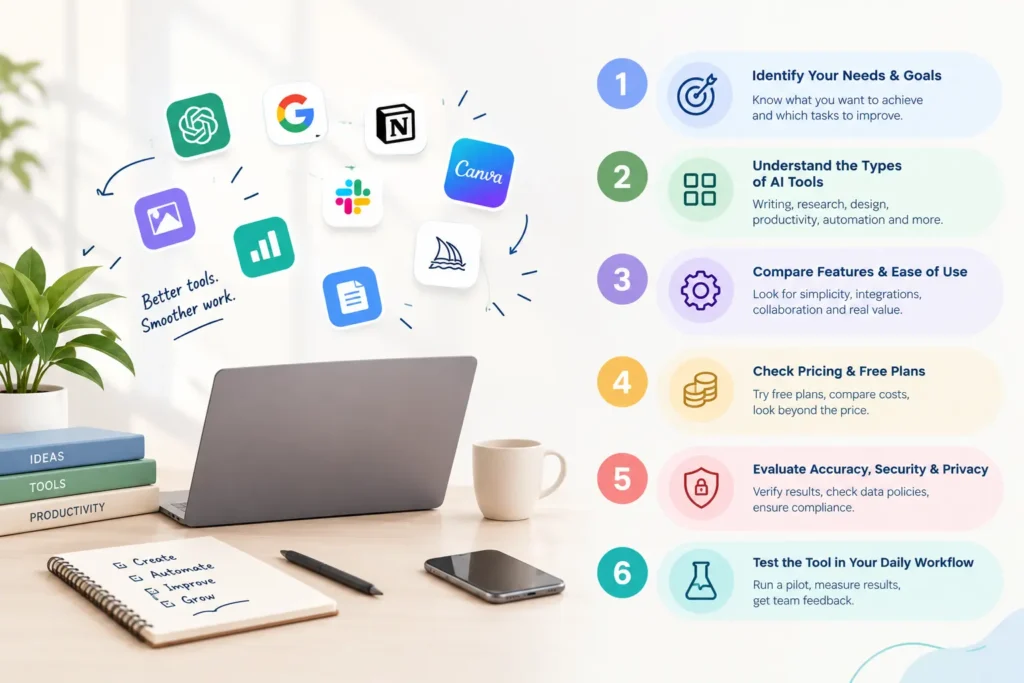
4. Check Pricing and Free Plans
AI tools come with different pricing structures, including free plans, monthly subscriptions, annual memberships, and usage-based billing.
Start with a free plan or trial whenever possible. Test the tool on real tasks before committing to a paid subscription.
Look beyond the advertised price. Consider usage limits, premium features, additional user fees, and the cost of integrating the tool into your existing systems. A more expensive tool may offer better value if it saves significant time or replaces several separate subscriptions.
5. Evaluate Accuracy, Security, and Privacy
AI-generated content is not always accurate. Some tools can produce outdated information, incorrect answers, or misleading results. Test important outputs and verify facts before using them in professional work.
Security is equally important. Review the provider’s privacy policy, data retention practices, and options for controlling how your information is used. Avoid uploading confidential business documents, personal information, or sensitive customer data unless the tool’s protections and your organization’s policies permit it.
For business-critical tasks, consider access controls, compliance requirements, and human review processes.
6. Test the Tool in Your Daily Workflow
Before adopting an AI tool across your organization, run a small pilot project. Use it for a week or two and measure whether it improves your work.
Track useful indicators such as time saved, output quality, error rates, and overall cost. Ask team members for feedback and identify any problems with the learning curve or integration.
Keep the tool only if the results justify the investment.
Conclusion
Choosing the right AI tool for your workflow starts with understanding your needs, comparing relevant features, checking pricing, and evaluating security. Most importantly, test potential tools using real tasks instead of relying solely on advertisements or recommendations.
The right AI solution should make your work easier, not more complicated. By focusing on practical value and measurable results, you can build a smarter, more efficient workflow that supports your goals.