
With spreadsheets, emails and the old fashioned bits of paper, the process of keeping track of customers can get cumbersome as the business expands. Customer Relationship Management (CRM) systems are designed to help businesses keep track of their customer information, sales activities, automate some repetitive, time-consuming tasks, and improve customer relationships.
With hundreds of CRM platforms available, however, finding the right one can be tricky. The most successful CRM is not the one that has the most features, it is the one that matches your business’s needs, your budget and the future of your business.
Here are the tips for picking up the best CRM for the business that is growing.
Determine the requirements of your business
But first, identify what needs are at play before comparing CRM platforms that are perfect for your business.
Start by asking:
- How many customers are under management?
- How many people are there in your sales team?
- Are you a Registered Manager looking for lead management?
- Is it essential for you to go for email marketing or automation?
- Are multiple teams going to be using the CRM?
- Do you require reporting & analytics?
Small businesses can just need contact management plus sales tracking; whereas, a growing organization may want automation and customer support that includes integrations and advanced reporting.
It will be easier to weed out options when you have a list of those you want to be included.
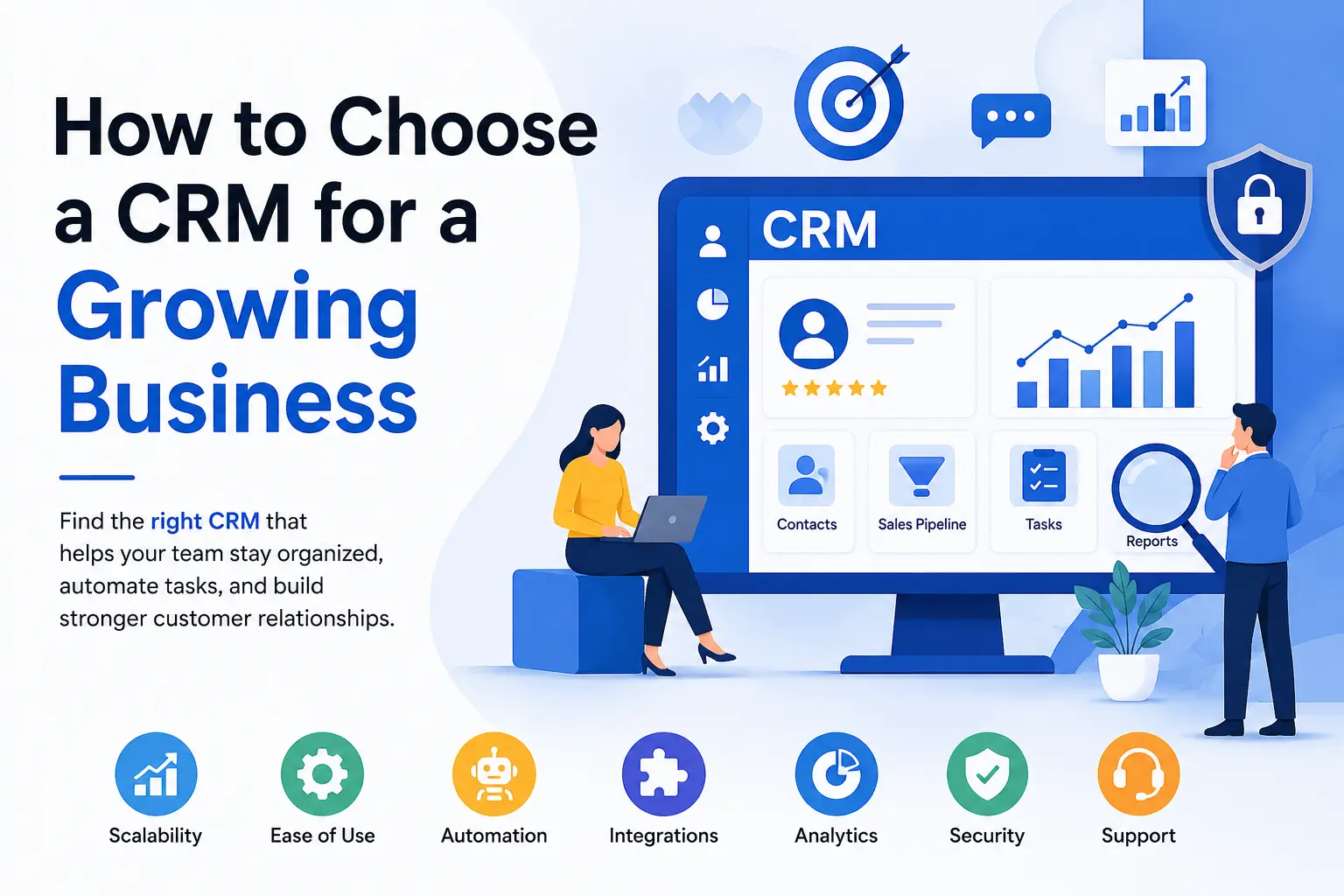
Look for Scalability
A CRM should be able to grow with your business.
Now you have a small team of employees working for you right now, but in the next several years your customer base and sales team as well as your data could have grown immensely. Having a CRM that will end up being too costly or restrictive as you expand could very well push you to move on to yet another application in the future.
Check for features such as additional users, flexible workflows, automation tools, advanced reporting and also flexible pricing structures.
Focus on Simplicity of Use
If the team doesn’t use the CRM, it does little to nothing.
Having a complex system can make employees develop redundant skills and hinder adoption. Seeking clean interface, easy browsing, viable dashboards, and accessible sales pipelines.
There are several CRM vendors that will provide complimentary or free trials or demos. Use them for your team’s testing to make a decision.
Check Automation Features
Growing businesses stand to gain huge time saving advantages from automation.
Any task that can get automated like assignments of leads, follow up reminders, email communication, data information, sales workflows can be managed easily through a good CRM. This frees up your team’s time for communicating with customers instead of time spent on administrative matters.
Instead of just picking a CRM with basic contact-management functions, evaluate the workflows carefully should automation be a key concern of your business.
Consider Integrations
Your CRM should not be a standalone system.
See if the platform seamlessly integrates with the tools that you are already using and familiar with such as email, accounting software, and marketing platforms, communication applications, calendars and project management software.
Good integration can minimize duplicate data entry and streamline workflow between departments.
Analyze Reporting and Analytics
The more your enterprise grows, the more crucial it is to make well-informed choices using solid data.
Seek out the CRM capabilities which support you monitor the sales performance, conversion rate, client task, pipeline worth, and also team performance.
Mobile dashboards and reports offer managers a way to interpret what’s going well and what is not.
Compare Pricing Carefully
CRM costs may vary widely among service providers.
Don’t just focus on the starting price. Look into extra users, higher brow features, storage requirements, integrations, automation, and support.
Think about what you can afford, the monthly outgoings and what you should expect to spend in the future. If your business has the scalability or functionality they require, then a slightly higher cost CRM may be worth the investment.
Consider Customer Support and Security
Consistent and appropriate customer support is extremely valuable when implementing a new CRM.
Look at the documentation, tutorials, live chat, and email or other assistance the provider provides. Additionally, examine the security measures, data protection policies, backup plans and access control systems in place at this platform.
Final Thoughts
Installing a CRM is a critical long-term decision when choosing one for a growing business. Develop for your needs now, and be aware of possibilities for growth in the future.
The right CRM is supposed to be user-friendly, scalable, safe, adaptable, and easily be incorporated with the existing tools that you’re used to working with. Don’t just go for the platform with the longest list of features, instead pick a platform that will make your team work more efficiently and promote a stronger customer relationship.
Sign up for free trials, have your team involved, and make sure to do a price comparison. As your company evolves, a well-designed Salesforce can become a crucial element of your business.