
As we venture into the digital landscape of business, organisations are greatly depending on technology to run their business objectives, enhance their clients’ encounters, and also sustain their development. The Customer Relationship Management (CRM) and Enterprise Resource Planning (ERP) systems are two of the most significant software solutions that can be found. While sometimes compared, they are used for different functions and resolve various Corporate problems.
When it comes to deciding between a CRM and ERP to service a business, there are numerous business owners who find themselves unsure of which would work best. The decision on which option is the best will depend on the size, complexity of the workings and future plans for the business. It can serve to get a better handle on the operations of each system and guide organizations toward informed investments in the technology.
What is a CRM?
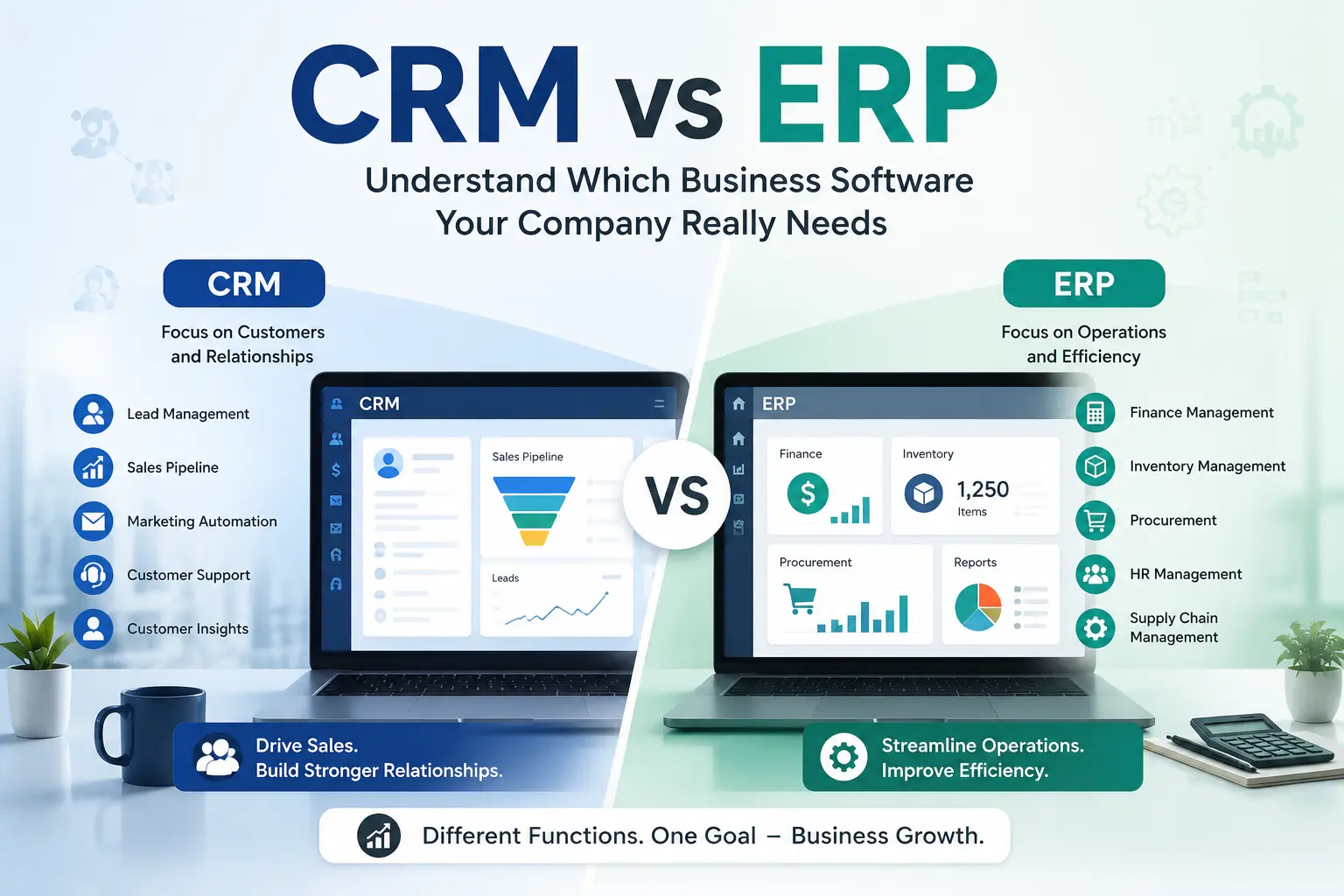
Customer Relationship Management (CRM) is a system created to manage Customer interactions and potential customers. It assists in making sales, marketing and customer service more effective and efficient by storing customer data in a single system.
A CRM can help companies to follow leads, track sales opportunities, document customer interactions, automate follow-ups, and analyze consumer activities. Through providing teams with a comprehensive customer view, CRM software contributes to enhancing customer relationships and boosting sales efficiency.
If acquiring a customer and keeping them is critical for your business, CRM software could be a tool that aids in growth.
What is an ERP?
Enterprise Resource Planning (ERP) Software are the solutions to handle the inner workings of a business. Unlike customer-driven ERP, it integrates several departments like finance, inventory, purchasing, HR, manufacturing, and supply chain management etc.
An ERP system provides a single business data source of truth. This ensures information consistency across departments, making for a more streamlined and efficient operation with fewer errors.
ERP is useful in companies that deal with many financial transactions, complex production processes or purchases.Businesses that handle inventory, production, purchasing or sophisticated financial procedures can reap thoughtful advantages from ERP implementation.
The Main Difference Between CRM and ERP
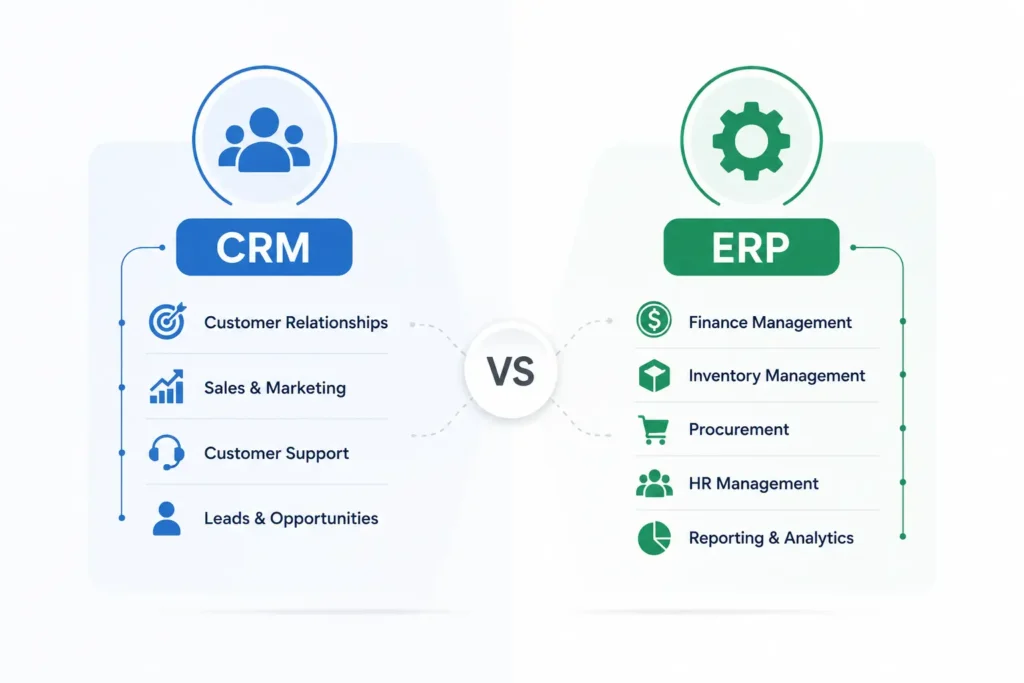
The main difference between CRM and ERP is that one will focus on the customer, while the other will focus on the business. CRM is customer-centric and ERP is operations-centric.
In the business world, CRM is used to generate revenue as it improves the customer relations and the sales process. ERP can help streamline internal operations and resource management, leading to increased efficiency for businesses.
In summary, CRM deals with external relationships and ERP deals with internal processes.
Understand How CRM Can Help a Business Grow
By enabling businesses to track and manage each stage of the customer journey, CRM systems enhance interactions with customers and help build better customer relationships. Sales teams can follow up with prospects; marketing teams can develop marketing campaigns more efficiently; and customer service teams can resolve problems more efficiently.
Giving businesses the ability to keep all of their customers’ interactions in a single location, this means they can make it personal to each customer and have an earlier reply method for meeting the customers’ needs. This frequently results in increased customer satisfaction, greater retention rates and higher revenues.
Businesses that have a growing sales team, subscription services, consulting and customer-oriented business find CRM software more helpful.
How is ERP Beneficial to Operational Efficiency?
An ERP system enables companies to function better in terms of automating repetitive operations and bridging departments. Financial reporting is more accurate, inventory management is more efficient, procurement processes are streamlined, and resource planning is simplified.
Real-time access to operational data will enable management to make quicker and more informed decisions. Another benefit of ERP is that it eliminates data duplication, reduces manual errors and enhances productivity in the organization.
ERP can give companies the framework to sustain their growth in the event of operational delays or a period of consultation growth.
Which System Should You Go For?
The decision of whether to go for CRM or ERP depends on your business’s current priorities.
A CRM system is generally the more suitable option when you are looking to improve relationships with your customers, sales, or customer service.
Based on business goals and needs, if the priority is to manage inventory, control finances, improve operational efficiency, coordinate multiple business departments or manage complex business processes, an ERP system is definitely the better investment.
Many small businesses start with a CRM system because it’s more likely to be easier and cheaper to implement. The business can need the ERP system when it expands and turns out to be more intricate.
Why Many Businesses Use Both
There is no competition between the two systems of CRM and ERP. They collaborate with each other in many organizations.
A salesperson, for instance, can successfully close a sales order in the CRM and this can be automatically translated to the ERP system, covering inventory allocation, invoice creation, shipping, and financial reporting. The integration helps prevent duplicate tasks and allow all departments to have access to accurate data.
Both systems, when used together offer better forecasting, quick order processing, better customer service and better financial visibility.
Final Thoughts
Don’t make the choice of CRM or ERP based on industry trends; you should make it in line with your business requirements. In addition to better business growth, CRM can boost customer relationships and sales opportunities. But ERP works to enhance the operational efficiency and internal coordination, enabling businesses to scale effectively.
With the growing acceptance of digital transformation, many find that CRM and ERP can provide an organization with a strong technology backbone. Companies which are able to link through to customer data with operational data will be more likely to better boost productivity, enhance customer experiences, and realize sustainable business development.