
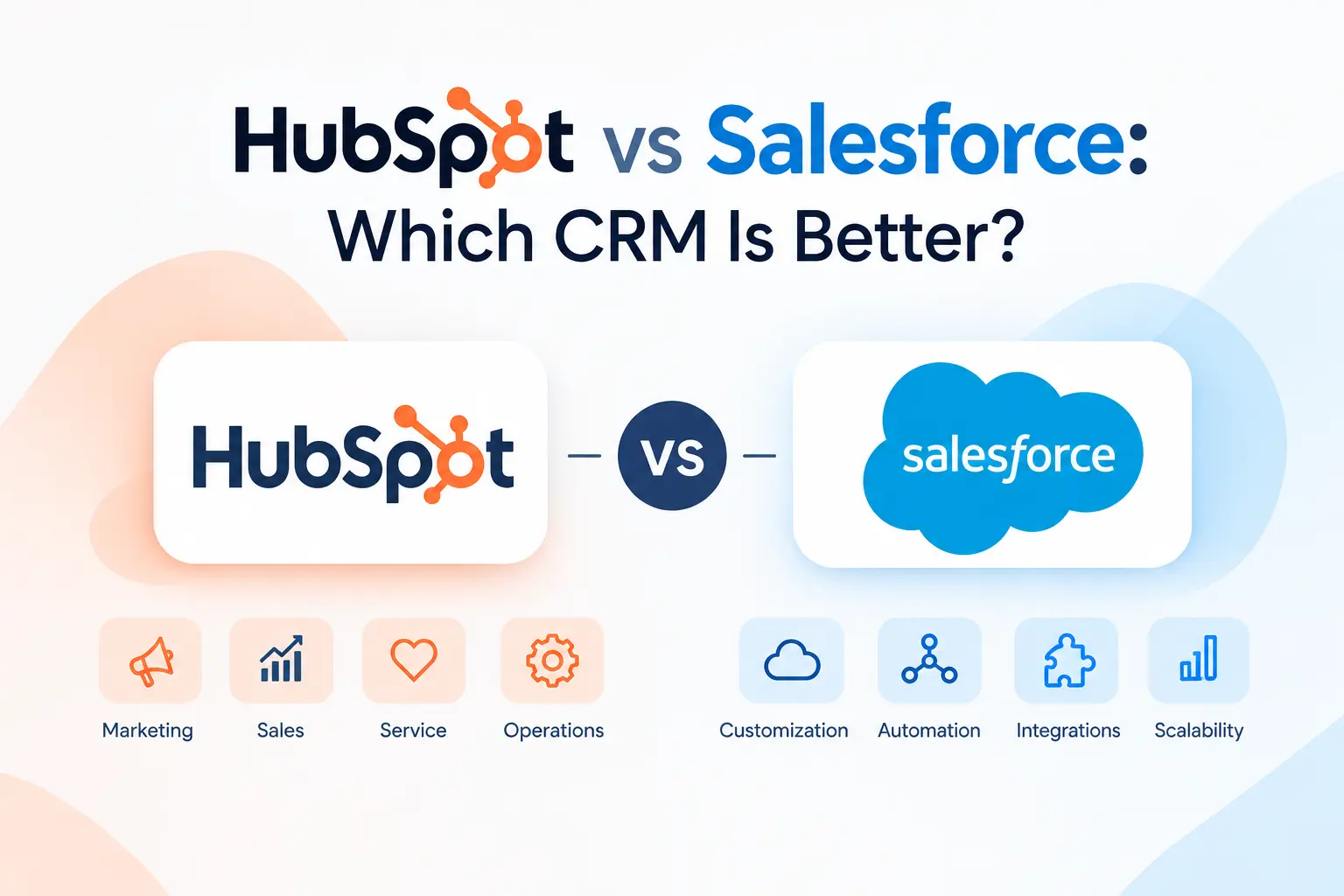
Choosing the right customer relationship management (CRM) software can have a major impact on how efficiently your business manages leads, customers, sales, and marketing. Two of the biggest names in the CRM market are HubSpot and Salesforce.
Both platforms offer powerful features, but they are designed with slightly different types of businesses and users in mind. So, which CRM is better: HubSpot or Salesforce?
The answer depends on your business size, budget, technical requirements, and growth plans.
HubSpot: Simple and Easy to Use
HubSpot is well known for its user-friendly interface and all-in-one approach to sales, marketing, customer service, and CRM.
One of HubSpot‘s biggest advantages is that businesses can get started relatively quickly. Its CRM includes tools for managing contacts, tracking deals, monitoring customer interactions, and organizing sales pipelines.
HubSpot is particularly attractive to startups and small businesses because it offers a free CRM option with useful features. As a company grows, it can add paid features and additional hubs for marketing, sales, service, and operations.
For teams that don’t have dedicated technical staff, HubSpot can be easier to set up and manage.
Salesforce: Powerful and Highly Customizable
Salesforce is one of the most established CRM platforms and is widely used by larger organizations.
Salesforce offers extensive customization and automation capabilities. Businesses can build complex sales processes, create custom workflows, integrate third-party applications, and manage sophisticated customer data.
Its flexibility makes Salesforce a strong choice for companies with complex requirements or large sales teams.
However, that flexibility can also make Salesforce more difficult to learn and configure. Businesses may need more training, technical expertise, or professional support to get the most from the platform.
HubSpot vs Salesforce: Features
Both platforms cover core CRM functions such as contact management, lead tracking, sales pipelines, reporting, automation, and customer service.
HubSpot stands out for combining CRM with marketing and customer-service tools in a relatively straightforward ecosystem. This makes it appealing to businesses that want multiple functions managed from one platform.
Salesforce focuses heavily on customization, scalability, automation, and advanced CRM capabilities. It can be a better fit for organizations that need highly specific workflows and extensive integrations.
Which CRM Is More Affordable?
Cost depends heavily on the features, number of users, and services your business requires.
HubSpot can be an attractive starting point for small businesses because its free CRM provides basic functionality without requiring a large initial investment.
Salesforce typically makes more sense for businesses that are prepared to invest in a more sophisticated CRM system. While the total cost can increase with advanced features, customization, implementation, and additional services, larger organizations may find the investment worthwhile.
Before choosing either platform, businesses should calculate the total cost rather than comparing only the starting subscription price.
Which CRM Is Better for Your Business?
Choose HubSpot if you want an easy-to-use CRM, quick implementation, integrated marketing tools, and a solution suitable for growing teams.
Choose Salesforce if you need advanced customization, complex workflows, extensive integrations, and a CRM that can support sophisticated enterprise requirements.
For startups and small businesses, HubSpot is often the easier starting point. For larger organizations with complex sales operations, Salesforce can provide greater flexibility.
Final Verdict
HubSpot and Salesforce are both excellent CRM platforms, but they serve different priorities.
HubSpot is the better choice for simplicity and an integrated business experience, while Salesforce is stronger for customization, scalability, and complex CRM requirements.
Before making a decision, consider your team’s size, sales process, budget, technical resources, and long-term goals. The best CRM isn’t necessarily the one with the most features—it’s the one your team can use effectively to build better customer relationships and grow your business.