
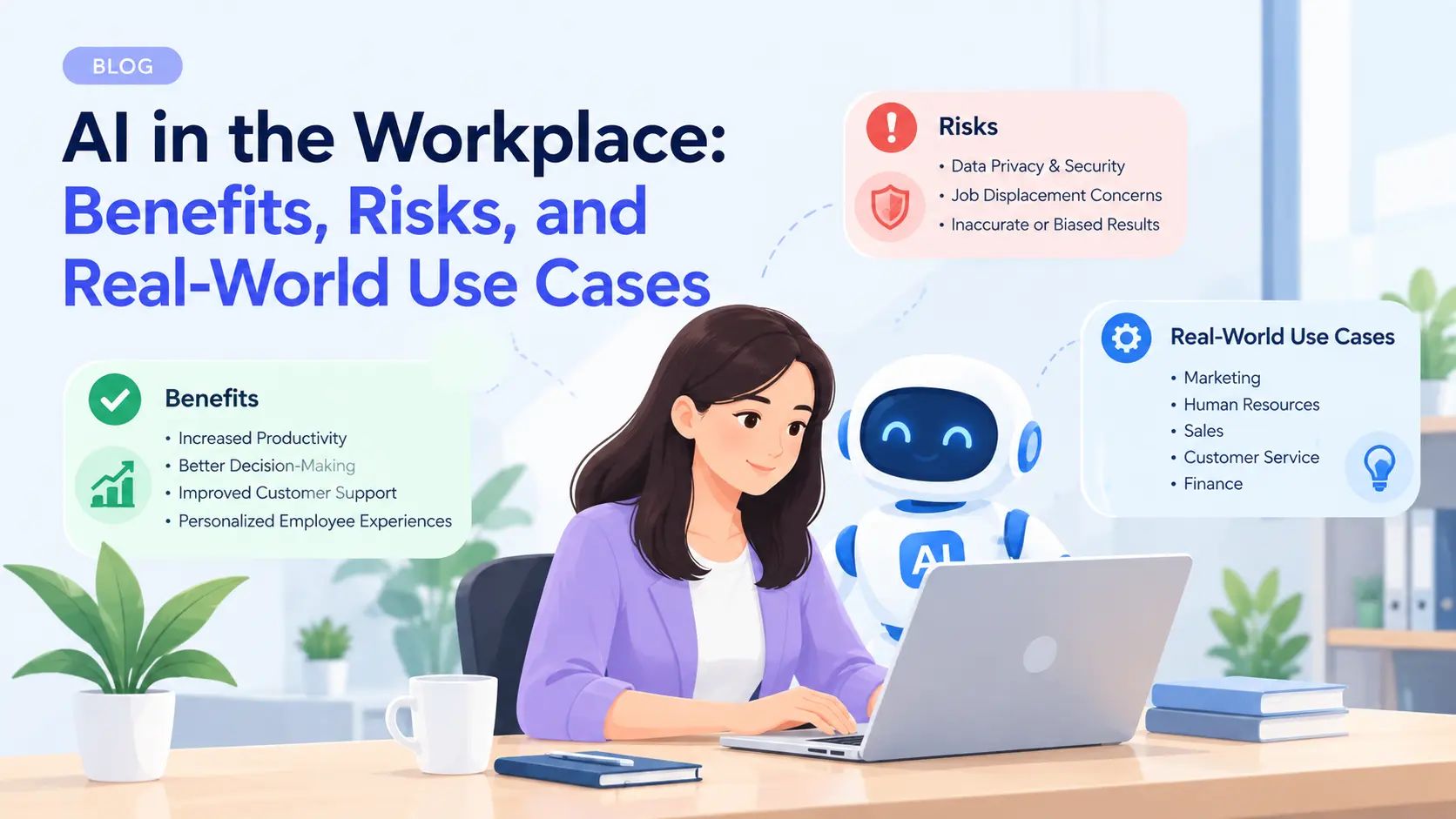
Artificial intelligence (AI) is rapidly becoming part of the modern workplace. From automating repetitive tasks to helping employees analyze information and communicate with customers, AI is changing how businesses operate. While AI can improve productivity and efficiency, it also introduces challenges that organizations need to manage carefully.
Understanding both the benefits and risks of workplace AI can help businesses adopt these technologies responsibly and effectively.
Benefits of AI in the Workplace
1. Increased Productivity
One of the biggest advantages of AI is its ability to automate repetitive and time-consuming tasks. Employees can use AI tools to summarize documents, organize information, draft emails, analyze data, and generate reports.
By reducing manual work, employees can spend more time on strategic, creative, and customer-focused activities.
2. Better Decision-Making
AI can process large amounts of data much faster than humans. Businesses can use AI-powered analytics to identify patterns, forecast demand, monitor performance, and support decision-making.
For example, a sales team can analyze customer behavior to identify potential leads, while managers can use business data to understand changing market trends.
3. Improved Customer Support
AI-powered chatbots and virtual assistants can provide customers with quick answers to common questions. They can operate around the clock and handle multiple conversations simultaneously.
Human employees can then focus on complex issues that require empathy, judgment, or specialized knowledge.
4. Personalized Employee Experiences
AI can also improve internal workplace experiences. Businesses can use AI to recommend training resources, assist employees with internal searches, and personalize learning programs based on individual needs.
This can make employee development more efficient and accessible.
Risks of AI in the Workplace
Despite its benefits, workplace AI comes with important risks.
1. Data Privacy and Security
AI systems often process large amounts of information, including business and customer data. Poorly managed AI tools can create privacy and security risks.
Organizations should establish clear policies about what information employees can enter into AI systems and ensure that sensitive data is properly protected.
2. Job Displacement Concerns
Automation may change the responsibilities associated with certain jobs. Some repetitive tasks may increasingly be handled by AI, requiring employees to develop new skills.
Rather than viewing AI solely as a replacement for workers, businesses can focus on using AI to augment human capabilities while investing in employee training and reskilling.
3. Inaccurate or Biased Results
AI systems can sometimes generate incorrect information or produce biased results based on the data used to train them.
Employees should not automatically accept AI-generated outputs. Important decisions should include human review, particularly in areas such as hiring, finance, healthcare, and legal matters.
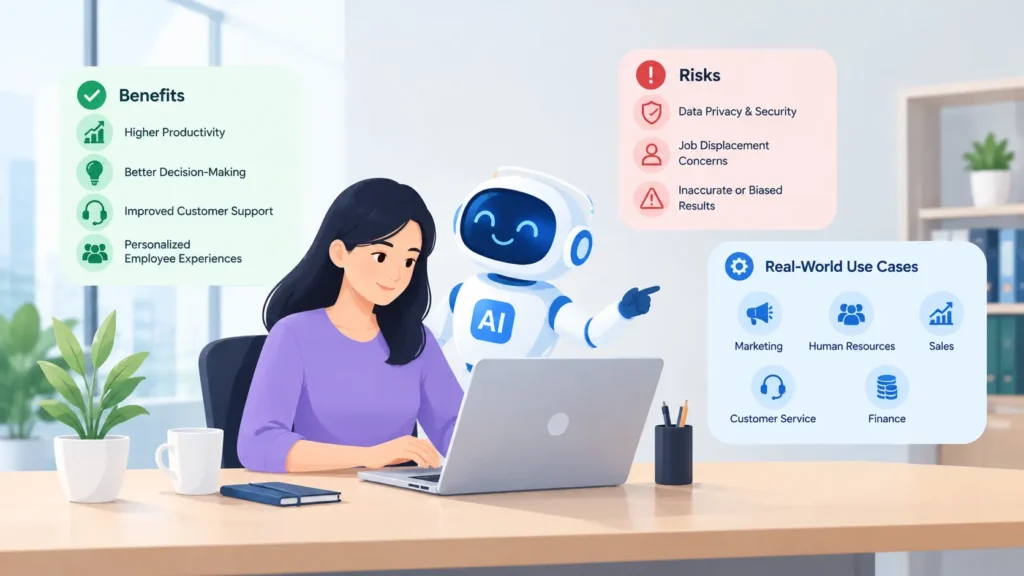
Real-World AI Use Cases
AI is already being used across many workplace functions.
Marketing: AI can help generate content ideas, analyze campaigns, segment audiences, and personalize customer communications.
Human Resources: HR teams can use AI for resume screening, employee support, onboarding assistance, and training recommendations, provided appropriate safeguards are in place.
Sales: AI can identify promising leads, summarize customer interactions, forecast sales, and automate follow-up tasks.
Customer Service: AI chatbots can answer frequently asked questions, route support requests, and assist customer service representatives.
Finance: Businesses can use AI to analyze financial data, detect unusual transactions, automate reporting, and support forecasting.
How Businesses Can Adopt AI Responsibly
Successful AI adoption requires more than simply purchasing new software. Businesses should identify specific problems AI can solve, establish data-security policies, train employees, and regularly evaluate AI-generated results.
Human oversight should remain an important part of the process. AI works best when it complements employees rather than operating without accountability.
Conclusion
AI is transforming the workplace by improving productivity, supporting decision-making, automating repetitive tasks, and creating new ways for businesses to serve customers. At the same time, organizations must address privacy, security, accuracy, bias, and workforce concerns.
The future of work is unlikely to be simply humans versus AI. Instead, businesses that successfully combine human judgment with AI capabilities may gain a significant advantage. The organizations that adopt AI thoughtfully, responsibly, and strategically will be better prepared for the evolving workplace.