
Artificial intelligence has become much more powerful in recent years, but even advanced AI models have limitations. One common problem is that large language models (LLMs) may not always have access to the latest information or specific private data. This is where RAG in AI becomes useful.
RAG stands for Retrieval-Augmented Generation. It is a technique that allows AI systems to retrieve relevant information from external sources before generating an answer. In simple terms, RAG helps an AI model find the right information first and then use it to create a more accurate response.
How Does RAG Work?
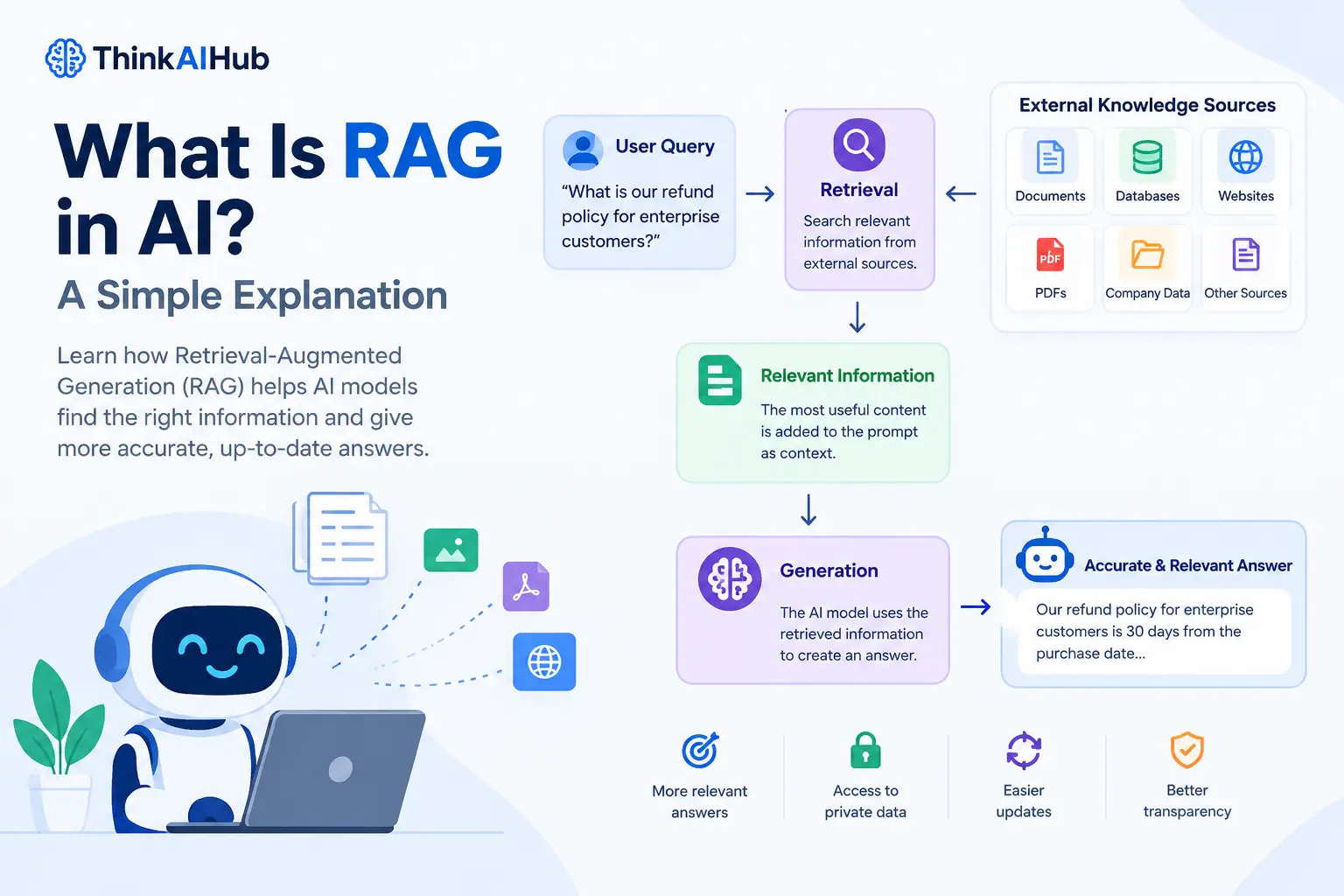
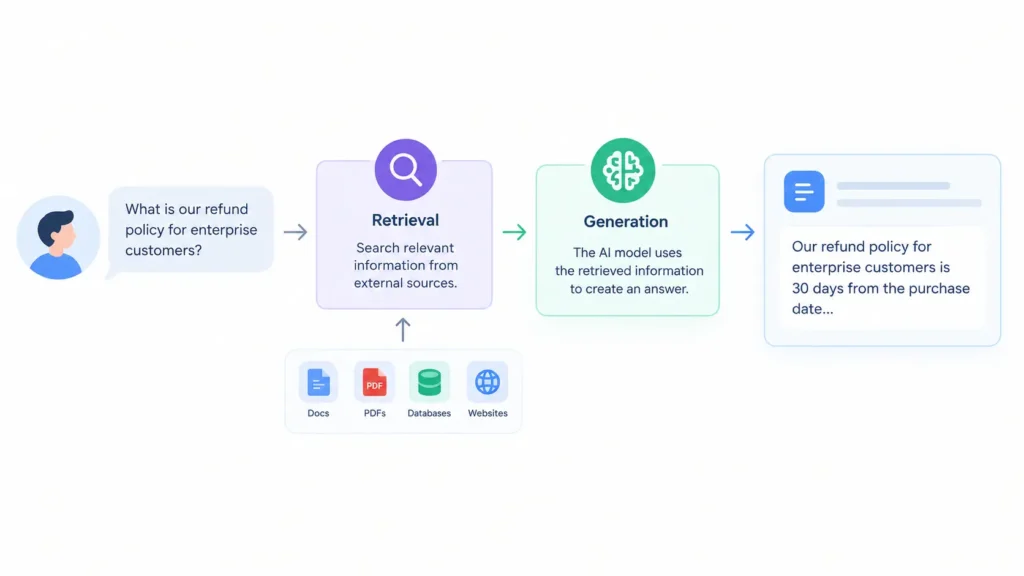
A typical RAG system has two main stages: retrieval and generation.
First, when a user asks a question, the system searches a connected knowledge source for information related to the query. This source could be a database, company documents, websites, PDFs, product documentation, or other structured and unstructured data.
The relevant information is then provided to the AI language model as additional context. The model uses this context to generate an answer.
For example, imagine a company has thousands of internal documents containing information about its products and policies. An employee could ask an AI assistant:
“What is our refund policy for enterprise customers?”
Instead of relying only on its general training, a RAG-powered assistant can search the company’s internal documents, retrieve the relevant policy, and generate an answer based on that information.
Why Is RAG Important?
One of the biggest advantages of RAG is that it can give AI models access to external and updated information.
Traditional AI models generally rely on the information available in their training data. That information may not include recent changes or private company data.
With RAG, businesses can connect AI applications to their own knowledge sources. This makes RAG particularly useful for customer support, internal knowledge bases, research, and document-based applications.
RAG can also help reduce the risk of AI hallucinations, where a model generates information that sounds convincing but is incorrect. By providing relevant source material as context, the AI has a better factual foundation for its response. However, RAG does not guarantee that every answer will be correct.
RAG vs Fine-Tuning
RAG and fine-tuning are sometimes confused, but they solve different problems.
Fine-tuning involves training a model further on a specific dataset so that it becomes better at particular tasks, styles, or behaviors.
RAG, on the other hand, gives the model relevant information at the time a question is asked.
For example, a business that frequently updates its product documentation may benefit from RAG because the knowledge source can be updated without retraining the entire AI model.
Common Uses of RAG
RAG is already useful across many industries and applications. Some common examples include:
- Customer support: Answer questions using product manuals and help-center content.
- Business knowledge assistants: Search internal company documents.
- Research: Retrieve relevant papers, reports, and reference material.
- Legal applications: Search large collections of contracts and documents.
- Healthcare information systems: Retrieve information from approved knowledge sources.
- E-commerce: Provide product information based on current catalogs.
- Education: Create AI tutors that reference course materials.
What Are the Benefits of RAG?
RAG can offer several advantages:
More relevant answers: The model receives information related to the user’s specific question.
Access to private data: Organizations can connect AI applications to internal knowledge bases.
Easier updates: Information can often be updated in the retrieval system without retraining the underlying language model.
Better transparency: A well-designed RAG system can provide references or citations showing where retrieved information came from.
Final Thoughts
RAG, or Retrieval-Augmented Generation, is an important technique for building AI applications that need access to specific, current, or private information. Instead of asking an AI model to rely entirely on what it learned during training, RAG allows the system to retrieve relevant information and use it as context when generating an answer.
As businesses increasingly use AI for customer service, research, productivity, and knowledge management, RAG provides a practical way to connect powerful language models with real-world information.
In simple terms, RAG gives AI a way to look up information before answering—making AI applications more useful for situations where accurate and relevant knowledge matters.