
The way people search for information online is changing quickly. For years, traditional Google Search has been the starting point for finding websites, products, answers, and news. Today, AI-powered search is introducing a different approach: instead of simply showing a list of links, AI search tools can understand questions, summarize information, and provide conversational answers.
So, what exactly has changed, and how does AI search compare with traditional Google Search?
What Is Traditional Google Search?
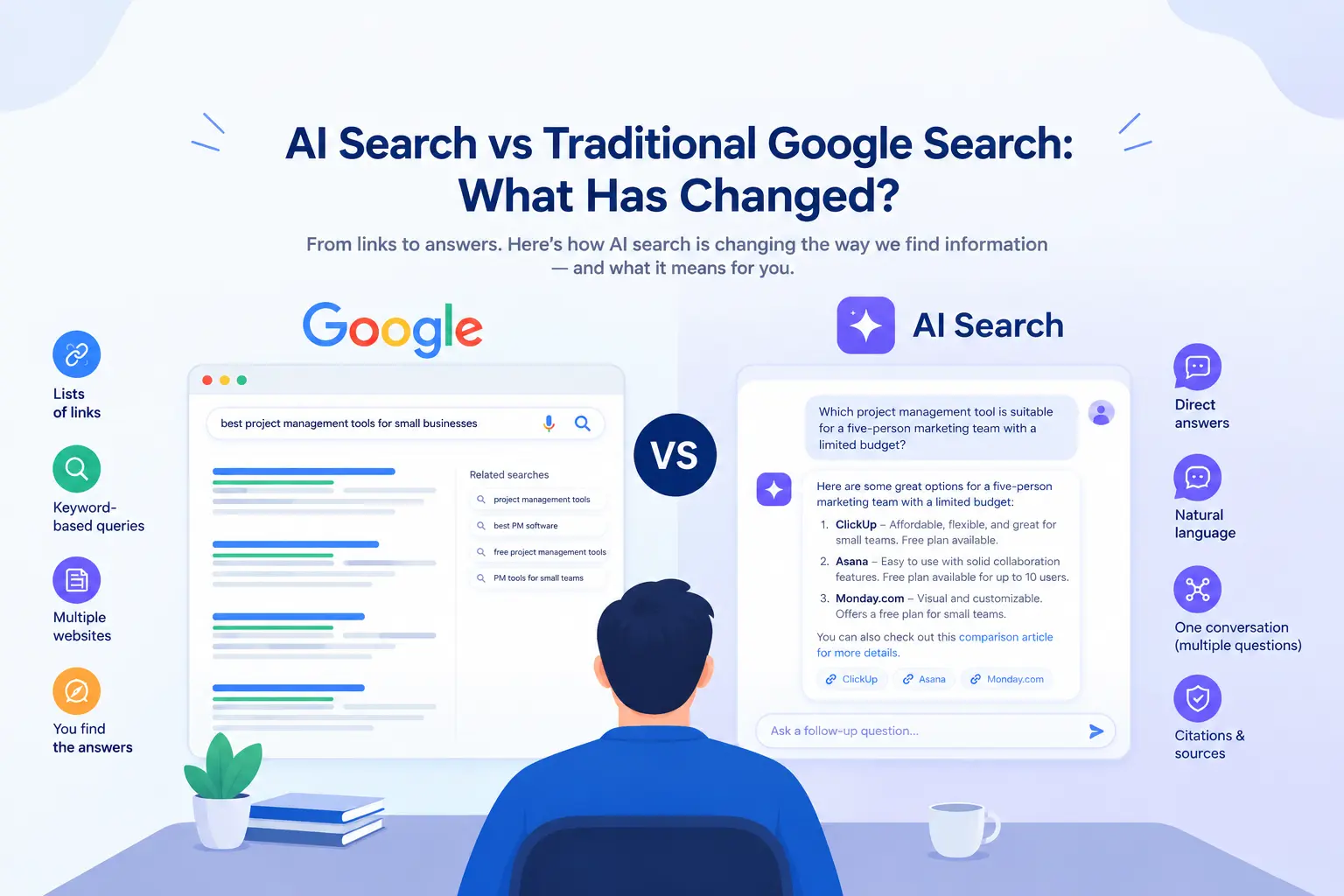
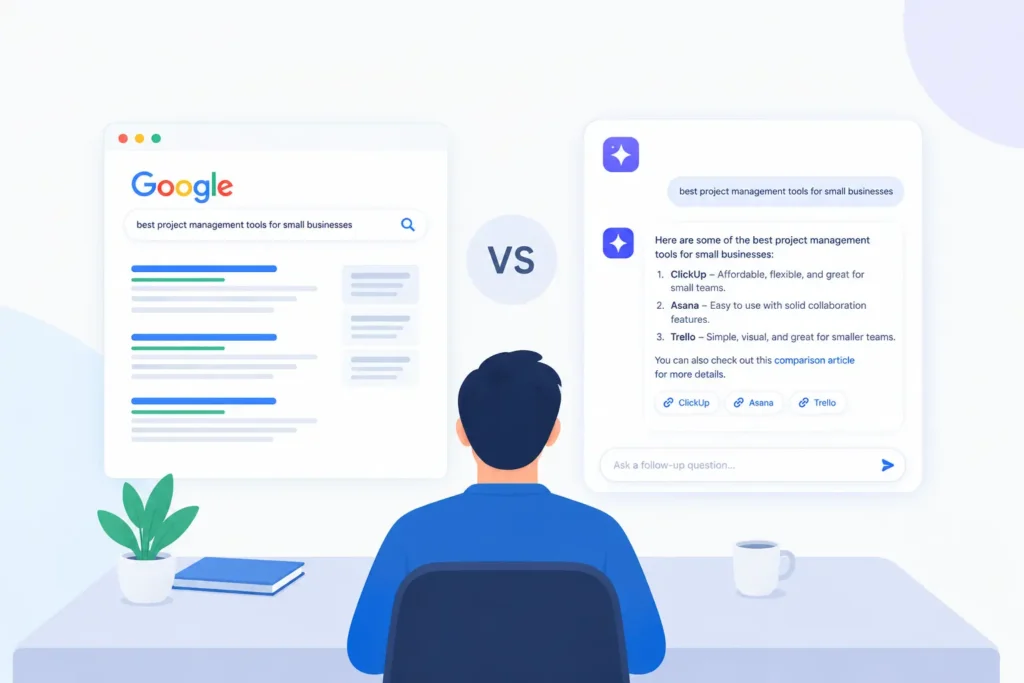
Traditional Google Search works primarily by matching a user’s query with relevant web pages. When you search for something, Google analyzes its index and presents results based on factors such as relevance, content quality, authority, location, and other ranking signals.
For example, if you search for “best project management tools for small businesses,” you may see a mixture of software websites, comparison articles, reviews, and other relevant pages.
The advantage of this approach is choice. Users can open several sources, compare information, and decide which one they trust.
However, traditional search often requires users to visit multiple websites before finding a complete answer.
What Is AI Search?
AI search uses artificial intelligence and large language models to understand the meaning and context behind a query. Instead of only returning links, AI-powered search can generate a direct response based on information it has processed.
For example, instead of searching separately for project management tools, their features, and pricing, you could ask an AI search engine:
“Which project management tool is suitable for a five-person marketing team with a limited budget?”
An AI search system can potentially analyze the requirements and provide a more conversational response.
Some AI search experiences can also provide citations or links to sources, allowing users to investigate the information further.
Key Differences Between AI Search and Traditional Search
1. Links vs. Answers
Traditional Google Search is largely built around links. AI search focuses more on providing synthesized answers.
This can make AI search feel faster for questions that require explanation or comparison.
2. Keywords vs. Natural Language
Traditional search has historically rewarded concise keyword-based queries, although Google has become increasingly capable of understanding natural language.
AI search is designed around conversational questions. Users can ask follow-up questions without necessarily repeating the entire context.
3. Multiple Searches vs. Conversations
With traditional search, researching a topic may involve several separate queries.
AI search allows users to continue a conversation. You might start with a general question and then ask for examples, comparisons, advantages, disadvantages, or recommendations.
4. Finding Sources vs. Summarizing Sources
Google makes it easy to discover original websites. AI search can reduce the need to open multiple pages by summarizing information directly.
However, this also makes source verification important. AI-generated answers can contain errors, outdated information, or incomplete context.
Is AI Search Replacing Google?
Not necessarily.
Traditional search remains useful when users want to find a specific website, shop for products, read original reporting, navigate to a service, or explore multiple sources.
AI search can be particularly useful for research, brainstorming, explanations, comparisons, and complex questions.
In reality, the two approaches are increasingly overlapping. Search engines are adding AI-generated answers, while AI platforms are incorporating web search and citations.
What Does This Mean for Websites and SEO?
The growth of AI search is also changing how businesses approach SEO.
Ranking for keywords is still important, but publishers increasingly need content that is accurate, useful, well-structured, and genuinely informative. Clear explanations, original research, first-hand experience, trustworthy sources, and strong topical coverage can help content stand out.
Businesses should therefore think beyond simply ranking for a keyword. The goal should be to become a reliable source that both search engines and users can understand and trust.
Final Thoughts
The biggest change from traditional Google Search to AI search is the shift from finding information to interacting with information.
Traditional search gives users a collection of sources to explore. AI search attempts to understand the question, combine relevant information, and present a conversational response.
Neither approach is perfect. For many searches, the best experience may actually be a combination of both: use AI to understand and explore a topic, then visit reliable original sources to verify important information.
As AI continues to become part of everyday search, the way people discover, evaluate, and consume information will continue to evolve.